
Lehigh County Active Warrants
Warrants in Lehigh County may be issued by a Court of Common Pleas judge, a Magisterial District Judge, or another authorized judicial officer, depending on the case type and stage. A bench warrant can appear after a missed hearing, probation issue, contempt matter, nonpayment issue, or failure to comply with a court order. A criminal arrest warrant may be tied to a complaint or investigation. A traffic or summary-case warrant may remain connected to the specific MDJ office that handled the citation or lower-court case.
The research did not confirm an official public countywide active warrant search maintained by the Lehigh County Sheriff's Office. That gap is important. A missing result from a public site does not prove that no warrant exists. Public docket entries, sheriff service information, police records, sealed warrant materials, and custody data are different record streams. A careful Lehigh County warrant lookup uses more than one channel.
The Sheriff's Office image comes from the official Lehigh County Sheriff's Office page.
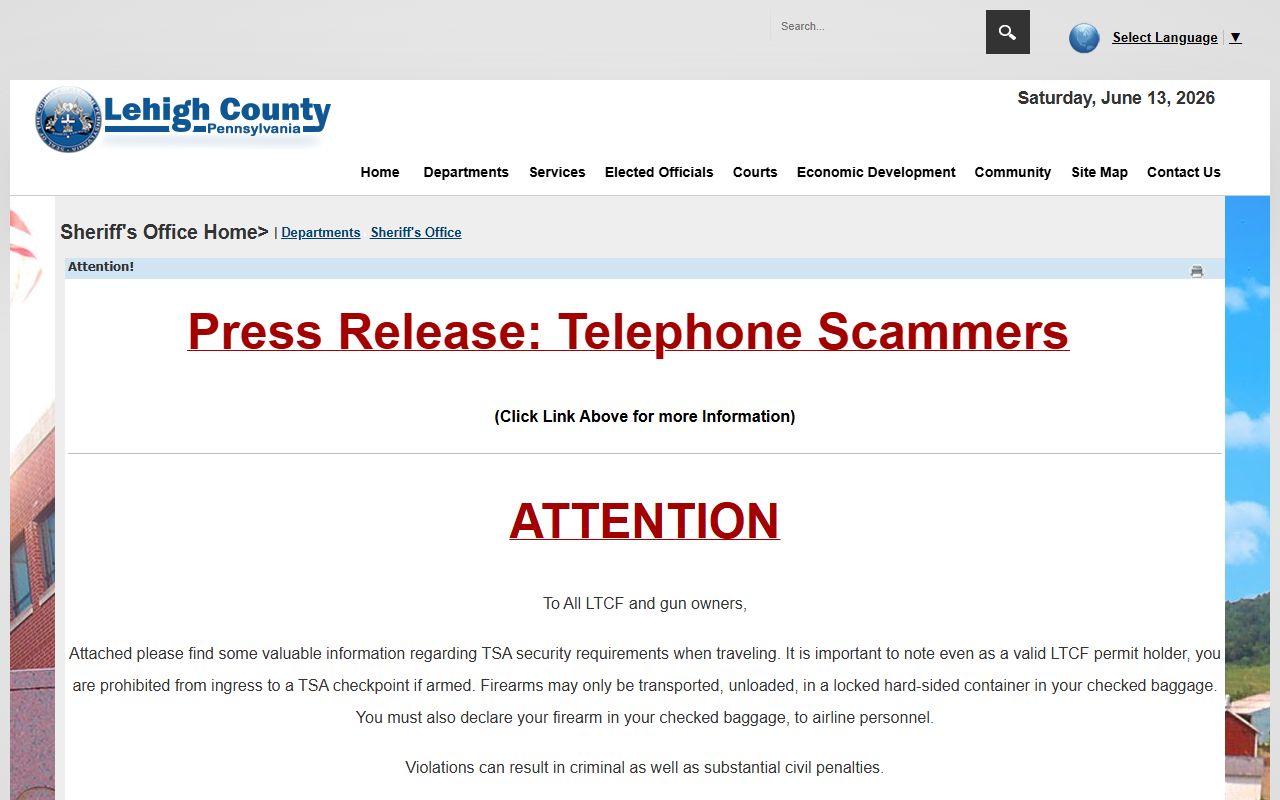
Use the Sheriff's Office as a court-services and warrant-process contact point, not as proof that every active warrant is posted online.
Lehigh County Warrant Types
Different warrant labels point to different records. A bench warrant usually comes from an existing court case. An arrest warrant can begin with a criminal complaint or investigation. A search warrant authorizes a search, and its details may stay sealed while an investigation is active. A failure-to-appear warrant or capias-style entry may be tied to missed court, unpaid obligations, probation, contempt, or traffic-case noncompliance.
- Bench warrant: usually issued by a judge after a missed hearing, contempt issue, probation matter, or failure to comply.
- Arrest warrant: authorizes arrest in a criminal matter and may not be visible on public search tools.
- Failure-to-appear warrant: often tied to missed traffic, summary, criminal, or probation court dates.
- Search warrant: authorizes a search of a place, device, vehicle, or property, and may be sealed or not docketed for public lookup.
- Probation violation warrant: may appear in criminal docket activity or require contact with court or probation channels.
How to Search Lehigh County Warrants
Start with the court record because many public warrant clues appear as docket entries. Use Pennsylvania UJS Case Search, the Common Pleas docket sheet report, or the Magisterial District Court docket sheet report. Search both court levels when the case may have started at an MDJ office and later moved to the Court of Common Pleas. Traffic, summary, landlord-tenant, and preliminary criminal matters often begin in MDJ court.
If a docket shows a warrant entry, call the court office listed on that docket. For an MDJ matter, call that specific Magisterial District Court office. For a Common Pleas matter, use the court or clerk routing shown on the docket. If represented, counsel should handle court contact. If the person may already be in custody, use Lehigh County Jail channels, VINELink, and Pennsylvania DOC tools as appropriate.
- Search UJS by docket number first, then by name and date range if the docket number is unknown.
- Check whether the docket is Common Pleas or Magisterial District Court before calling an office.
- Read recent docket entries for warrant issued, bench warrant, bail forfeiture, failure to appear, warrant served, or warrant lifted language.
- Contact the issuing court office listed on the docket for current instructions.
- Use jail, VINE, DOC, or federal custody tools only to check custody status after arrest or transfer.
Note: Do not rely on payment alone to clear a Lehigh County warrant unless the court confirms that payment resolves it.
Lehigh County Warrant Search Fields
Because no official public active-warrant database was confirmed, the most reliable public search-field table is the docket search path. The goal is to find a court case that may contain a warrant entry, not to run a standalone sheriff warrant list. A precise docket number is best. Names can produce false matches, and some warrants are sealed or too recent to appear in a public docket.
| Field Label | Type | Required | Notes |
|---|---|---|---|
| Court Type | Dropdown/report choice | Yes | Use Common Pleas for county trial-court cases and MDJ for lower-court matters. |
| County | Dropdown | Useful | Select Lehigh when the form provides a county filter. |
| Docket Number | Text | No | Best exact search. Common Pleas criminal dockets often include CP-39. |
| Participant Name | Text | No | Use full name and confirm identity against date and case details. |
| Date Range | Date fields | No | Narrows broad name searches and older warrant entries. |
| Case Type | Dropdown | No | Criminal, traffic, non-traffic, civil, and landlord-tenant options vary by report. |
What Lehigh County Warrants Show
When warrant information is visible on a docket, it is usually limited. It may identify the docket, issuing court, judge or MDJ, defendant, warrant type, trigger event, bail status, and later service or lifting of the warrant. It may not show the full warrant document, law-enforcement notes, sealed allegations, officer affidavits, or current arrest plans. Public view is shaped by court policy and safety rules.
| Field | What It Shows |
|---|---|
| Docket number | The case tied to the warrant entry, such as a Common Pleas or MDJ docket. |
| Issuing court | The judge, Court of Common Pleas division, or Magisterial District Court that acted. |
| Warrant type | Bench warrant, arrest warrant, failure to appear, probation violation, contempt, or related label if public. |
| Trigger | Missed hearing, nonpayment, probation issue, new complaint, contempt, or bail problem when stated. |
| Bail or bond status | Bail amount, no-bail status, forfeiture, or release conditions if the docket displays them. |
| Disposition | Whether the warrant was issued, served, lifted, vacated, or followed by commitment or bail posting. |
Resolve Lehigh County Warrants
A person who finds a possible Lehigh County warrant should not guess at the fix. Some warrants require surrender. Some require a hearing. Some require counsel to contact the court. Some traffic-related issues may involve PennDOT consequences in addition to court action. If represented, defense counsel should contact the court or District Attorney. If not represented and the case is criminal, the Public Defender may be relevant only after eligibility screening.
Before appearing, confirm the location, whether booking is expected, whether bail may be set, and whether a hearing will be scheduled. For MDJ cases, call the specific MDJ court listed on the docket. For Common Pleas cases, use the court or criminal records routing on the docket. After the warrant is addressed, check the docket to confirm it shows served, lifted, vacated, or otherwise resolved. For traffic cases, confirm that any license hold or PennDOT issue is also cleared if the court says it applies.
Important: A warrant can lead to arrest. Talk with counsel or the issuing court before deciding where to appear.
Lehigh Sheriff and Police Channels
The Lehigh County Sheriff's Office, led by Sheriff Joseph N. Hanna, handles sheriff services, court security support, service of certain court papers, licenses to carry firearms, sheriff sales, and law-enforcement functions assigned by county or state law. The office is separate from the Department of Corrections. A sheriff page can explain process and routing, but it should not be treated as a complete public list of every Lehigh County warrant.
The Sheriff's Office license-to-carry service page is also an official sheriff-source image in the manifest, from Lehigh County Sheriff's Office services.
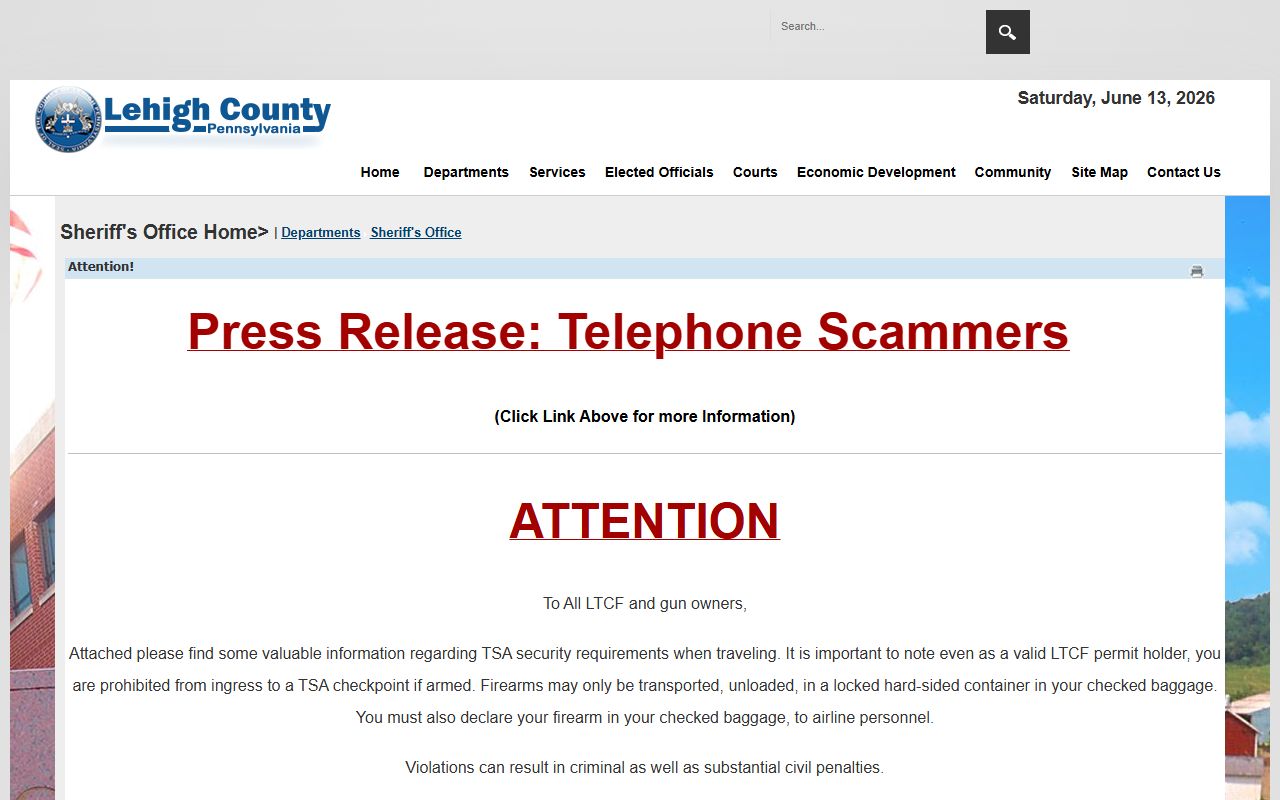
That source helps confirm the sheriff's public-service context, while court dockets remain the better public path for bench-warrant clues.
Police and District Attorney materials may involve active investigations. Those records can be exempt, sealed, or unavailable to the public while safety and prosecution issues remain open. A county Right-to-Know request can ask for administrative records, but it will not override criminal-investigation, juvenile, sealed-court, or safety exemptions.
Custody After a Warrant
After a warrant is served, the question often changes from warrant status to custody status. Lehigh County Jail and Department of Corrections pages are the local custody route. VINELink can provide custody search and notification where participating data is available. The Pennsylvania DOC inmate/parolee locator is for state prison or parole custody, not ordinary county jail pretrial custody. Federal custody uses federal tools such as the Bureau of Prisons locator.
A court docket may show bail and court events, but it is not a live jail roster. A jail or VINE result may show custody status, but it is not the complete criminal case file. For the court outcome, return to UJS and the Clerk of Courts record route.
Restricted Lehigh County Warrants
Some Lehigh County warrants are not public. Sealed warrants, juvenile warrants, active-investigation warrants, sensitive search warrants, and records involving protected victims or minors may be unavailable through public systems. Recent warrants may also lag behind public docket updates, and some entries may be removed from public view after expungement, limited access, or sealing.
Federal warrants are separate from county court records. Lehigh County is in the Eastern District of Pennsylvania for federal district court purposes, and federal warrant or custody questions may involve the U.S. Marshals Service, federal court, or federal custody systems. County clerks and the Sheriff's Office do not hold the full federal warrant record simply because a person lives in Lehigh County.